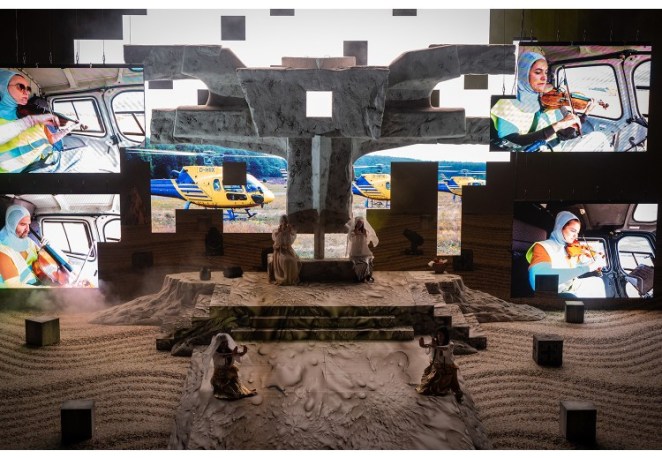
No one would ever have accused German avant-garde composer Karlheinz Stockhausen, who died in 2007 at the age of 79, of lacking ambition. Among his hundreds of pieces, he spent 25 years composing the seven-opera “Licht” (Light) cycle, one for each day of the week. Altogether the opus runs for 29 hours – longer, by some 13 hours, than Wagner’s “Ring” cycle. The Wednesday opera, “Mittwoch aus Licht”, is the best known of the seven in part because it includes a quartet that Stockhausen wrote for four string players to play while flying near the performance venue in four separate helicopters – with sound and pictures relayed back to the audience.
It costs a bomb to stage so no surprise that the premiere came five years after Stockhausen’s death, in Birmingham, England, and performances since have been few and far between. The first staging in his native Germany did not take place until this September, when the Deutsche Oper shelled out “viel Geld” to have “Mittwoch aus Licht” as its season opener.
It was, to state the obvious, an example of “event” opera and in that respect, making the effort to get to Berlin was well worth it. There was excellent choral and solo singing and instrumental playing (by the French ensemble Le Balcon) was of a very high calibre. The musical forces under the direction of French conductor Maxime Pascal – who has made a career of reviving all seven of the Licht operas – had been rehearsed to perfection. The performances were all the more remarkable because Pascal was nowhere to be seen during the opera, all his work was done beforehand. The instrumentalists, choristers, soloists and dancers were all on stage – no orchestra, or conductor, in the pit.
And what did the Deutsche Oper get for what was possibly the most expensive production it will mount this season, or, as one of the national German newspapers put it, an opera that was too expensive for the other 80 opera houses in Germany to stage?
First, let’s deal with the cod – pardon me, cosmic – dramaturgy that serves as the framework for what, it has to be said, is a splendid score by Stockhausen that stretches the limits of what you might expect to hear in an opera house in every direction, all at once, in a mostly good way.
As mentioned, this is the middle opera of a seven-opera cycle, each of which is assigned its own colour, theme, mineral, animal, and so on. “Mittwoch’s” theme is love, friendship and cosmic solidarity, its colour is yellow, its minerals are zirconium and topaz, its animal is a camel – it’s a whole page in the programme notes. The cycle also delves into the relationships among three biblical figures, Michael, Eve and Lucifer, each of whom has a bespoke series of notes – 13 for Michael, 12 for Eve and 11 for Lucifer – associated with them. That is a big help, since at any given time they might be represented by a singer, an instrument or a dancer – so listen closely!
The staging and direction by German theatre director Susanne Kennedy emphasised the ritualistic aspects of what Stockhausen wrote. The stage is covered with a sand-coloured carpet and in the middle of the stage is a cross in which is embedded a screen that plays videos showing birds, sinuous passages through undefinable places and…more sand. The dancers spend a lot of time pouring sand here and there.
The first scene, kicking off what amounts to 4 1/2 hours of opera, including intermissions, but not including the electronic ambient music that precedes and ends the opera, is called the “World Parliament” and is just what it says on the tin. Some 40 choristers from the Deutsche Oper chorus, dressed in monk-like garments, stand in what is meant to be a glass room and sing about peace and love; they do not debate. Could be monotonous except that at one point an announcement summons the “President”, chorus master Jeremy Bines, to his car because it is about to be towed away. A bit later a soloist sings “Love is forgiveness”, to which Bines responds “Not always” and the men’s chorus intones: “I see”. It was beautifully sung by the a cappella choristers and made for an awesome beginning.
The next scene is the “Orchestra Finalists”, which could be seen as Stockhausen’s take on Luciano Berio’s fiendishly difficult “Sequenzas” for individual instruments. Stockhausen has written complex solos for 11 instruments, with the difficulty compounded by physical challenges. The trombonist, for example, plays while turning around in a circle. The double bass player performs while spouting out sequences of numbers in German. An electronic soundtrack that sometimes features bird calls, other times children’s voices, and later night-time insects, plays in the background. It grabs your attention.
Scene 3 is the renowned “Helicopter Stringquartet” which, pardon the pun, is a bit of comedown from the musical heights scaled in the first two scenes. Stockhausen loved flying so the pairing of music and helicopters, if improbable, came to him naturally. You might well ask how do four musicians flying in separate helicopters synchronise their playing – especially over the roar of the rotors – and the answer is what musicians use for rock concerts and movie scores – a click track. To underscore how that works, at various times in the 30-minute performance each of the four musicians yells out a number in German – “eins, zwei, drei, vir” – so you know they are in synch. The performers in mid air are projected onto screens in the opera house, the music is piped in. The problem is that Stockhausen gave the musicians very little variety in their parts – they play mostly the same notes over and over, in time with the rotors. It’s a bit frenetic and monotonous. Plus you realise, from looking at the programme notes, that it was pre-recorded. Even the Deutsche Oper couldn’t afford to stage that for five performances.
After the second intermission we come to the opera’s Achilles heel – the “Michaelion”. This is the scene where Stockhausen’s fixation on the notion that he was receiving musical instruction from the star Sirius, or something along those lines, seems to have intruded. Delegates from throughout the universe have assembled to elect a new president. The favoured candidate, Lucicamel (the opera’s preferred animal surfaces) wins after performing a Camel Dance. He is appointed “Operator” which mostly means he stands out from the rest of the people on stage by walking around with a shortwave radio, to keep in touch with the universe. Six of the singers walk out into the audience, in effect making everyone in the house part of the cosmic assembly. The final sung words are: “Listen, mankind:”
Such sentiments might have seemed forward looking and futuristic in Stockhausen’s day, but at a time of global strife when the world is awash in dark political undercurrents, they seem dated at best, naive at worst. But Stockhausen was a composer. And for the music alone, it’s worth it.
By Michael Roddy

