By Michael Roddy
It was the opera coup of the year, perhaps the decade. The Metropolitan Opera, which is flailing under a mountain of debt and even looking to the Saudis for a bailout, enlisted Norwegian superstar soprano Lise Davidsen and American “baritenor” Michael Spyres for the title roles in Richard Wagner’s “Tristan und Isolde” – two lovers who can only be, and after 4 1/2 hours are, united in death.
Davidsen fans, myself included, are like Swifties. Hundreds of Taylor Swift fans flew from the U.S. to see her in Dublin. I returned the favour. I flew from Ireland to JFK to catch one of the eight sold-out performances of this once in a lifetime sonic extravaganza.
On that front, I was – for the most part – splendidly rewarded. Davidsen has a pure, crystal clear soprano voice that is sometimes described as being as strong as titanium, but can be gentle as a purring cat. Spyres, who hails from Missouri and studied in Vienna, styles himself a “baritenor” because he can sing in both ranges – so an ideal fit for Tristan, whose music dips frequently from the tenor into the baritone voice.
Also of note:
— Good supporting cast, including Russian mezzo-soprano Ekaterina Gubanova as Isolde’s maid Brangäne who, in typical Wagnerian fashion, serves her mistress and Tristan Love Potion No. 9 instead of the venom Isolde asked for? Check.
— The superb Met orchestra under the baton of the Met’s music director, Canadian conductor Yannick Nézet-Séguin, a bit rambunctious at times, but the chromatic and weirdly haunting score came through? Check.
— An unexpected and delightful twist of having the plaintive minor-key English horn solo in Act III that is usually played unseen in the wings performed on stage by Met horn player Pedro R. Diaz, in costume? Check
So what’s with the reservations regarding this seemingly splendid event? Ah, well, they would arise from the way this has all been packaged and presented to us, the audience, courtesy of American director and MacArthur Foundation “genius grant” winner Yuval Sharon and English set designer and Tony and Olivier award winner Es Devlin.
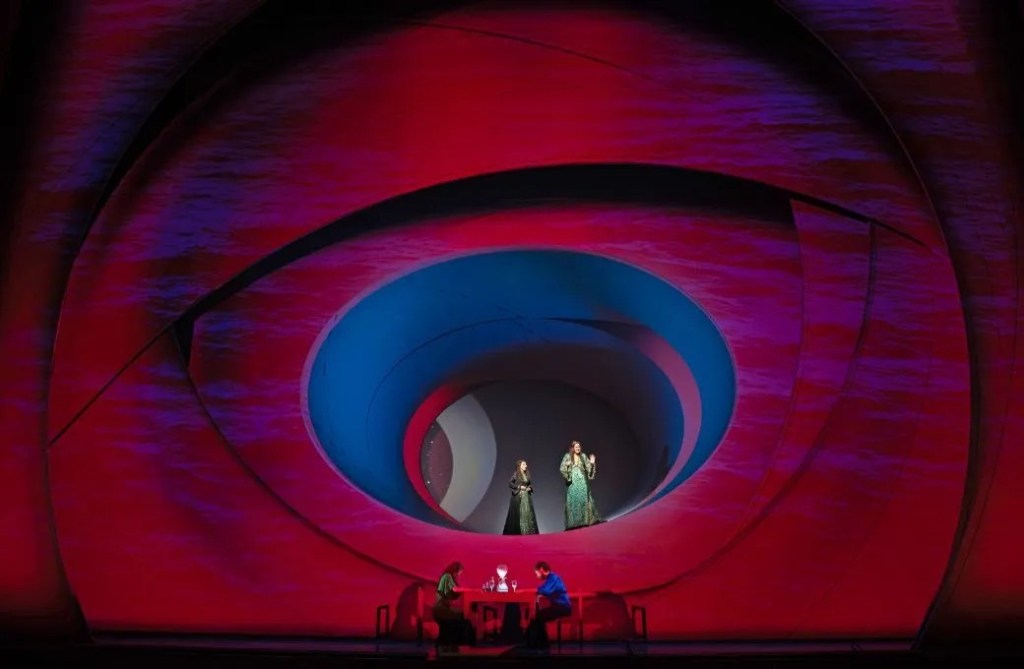
What we get is a stage in need of traffic congestion charges. It has dancers, it has doppelgangers for Tristan and Isolde, it has video projections including one of Spyres’s head that stretches from the stage to the top of the Met’s almost infinitely high proscenium. Instead of Isolde’s usual travel-pack of healing and magic potions she’s received from her mother, we get something that looks like the perfume display at the Dubai airport duty free.
And then there’s the iris – for such it resembles – which fills that entire huge proscenium, from side to side and stage to top. It opens up – as an iris would – to reveal an enormous cone stretching from the front of the stage – but positioned at least 20 feet above it – to some infinite point in the very back of the Met, possibly out onto Columbus Avenue. And that’s where Davidsen and Spyres do most of their singing.
The cone – or tunnel, let it be said, became a bone of contention for much of the Met’s audience, who do not sit in the hugely pricey seats in the orchestra/stalls or parterre but rather in the less hugely pricey dress circle, the two balconies or along the sides. And they were not well pleased.
“I disagree with many of the assertions of your reviewer,” Robert Jones of Washington, DC, wrote in a comment to the New York Times after Joshua Barone wrote a rave review.
“The midair tunnel does NOT bring the singers downstage; it is midway to the back wall at best. Thus most of the singing is delivered from an upstage position. And the tunnel, at least for this listener in the Grand Tier, swallowed rather than amplified, the singers’ voices.”
There were so many comments of this ilk that Barone, to his credit, went back to check the acoustics. And this is what he reported:
“On Wednesday, the performance was off from the start, with technical mishaps that presaged five hours of tentativeness and a seemingly contagious lack of energy. But in the Balcony, the biggest problem was the very thing I had been hearing about since opening night: erratic, suffocating acoustics that at their worst diminished Spyres and Davidsen. You would have thought their vocal power was slight. Nothing could be further from the truth.”
Barone blames two possible culprits, one of them the cone/tunnel.
“From the Orchestra level, the tunnels were only a problem when they erratically amplified the singers’ voices…But from the Balcony the performers, enveloped and hooded by the tunnels, were dampened.”
Second culprit: Nézet-Séguin getting too caught up in the music, overwhelming the singers.
“Few lines of the libretto could be made out over the playing, which from the Balcony was often so loud it reduced the singers to textures, like instruments in the ensemble.”
There is much more that could (and has) been said about this production in which Sharon, presumably under the authority of artistic licence, sees fit to have Isolde’s doppelganger (yes, they each have one, for the duration) give birth. This occurs while Davidsen is singing the “Liebestod” (the erotic “love death” of the doomed lovers) that is so beautiful – and which Davidsen sang so beautifully – it alone is worth the ticket, the hotel, the airfare and the Met’s $10 ginger ale.
Wagner, needless to say, brought down the final curtain on two dead lovers, sans squalling baby. No available synopsis of the opera, including the one for this Met production, mentions any offspring.
But you don’t, or at least shouldn’t, go to the opera for the frocks and sets. You go for Davidsen and Spyres and those talented musicians and Wagner’s score. And that, as Tristan and Isolde both learn at the end, is to die for.
 Irish Arts News