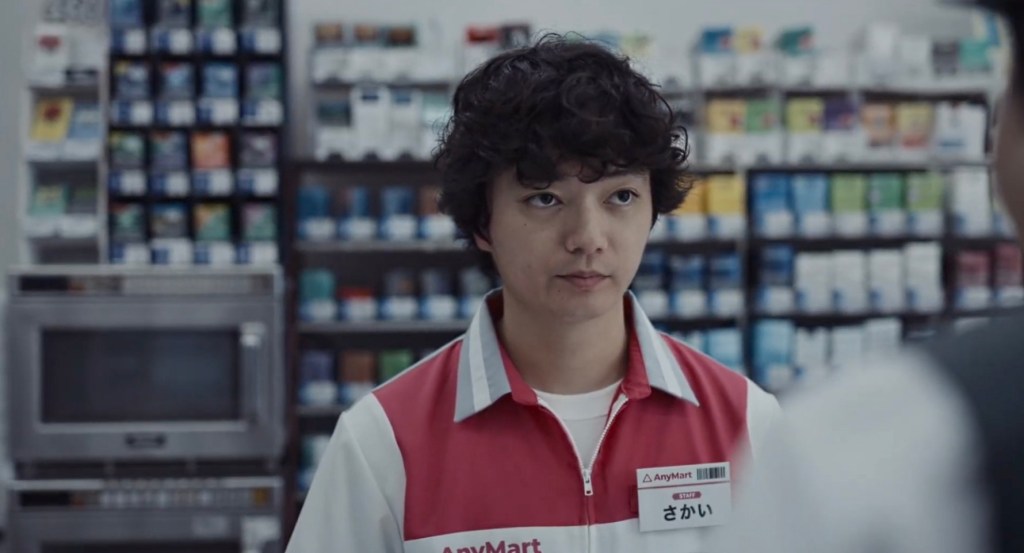
(Sometani Shota as clerk Sakai in Japanese horror/social commentary film “Anymart”)
By Michael Roddy
There is something not quite right in the Anymart convenience store, located in a nondescript neighbourhood in Japan and staffed by young uniformed employees who are, if nothing else, excessively agreeable and accommodating.
It turns out their every move and interaction is being monitored over CCTV and controlled from a back room by the shop’s boss (Masahiko Nishimura). He makes the workers recite a store pledge before starting work and is obsessed with them using a particular formulation of “please come again” when customers leave.
In the centre of this dehumanising workplace is young clerk Sakai (Sometani Shota), who somehow keeps up a cheerful, chatty disposition in the midst of the zombification of everyone and everything. He chats to co-workers outside the shop during cigarette breaks and meets up for hopeless rendezvous he’s arranged online with prospective girlfriends, one of whom wants to show him a picture of her dead dog.
If this sounds like a simmering cauldron of repressed emotions — including out and out hate — that could boil over anytime, then, yes, welcome to Japanese film “Anymart”. Classified as horror at the Berlinale, where it was shown in the Forum strand, it is also black comedy and social commentary rolled into one. It was also a sellout every time it was shown, including a late night screening on Sunday, the last of the festival..
Director Yusuke Iwasaki, whose day job is filming commercials, said at one of the screenings that the film had been in part inspired by what happened to his father when he went from being the owner of a liquor store where he enjoyed interacting with customers to running a convenience store where he became more withdrawn.
“My father had a very human touch. But eventually, he had to change the liquor store to a convenience store, and from then on, the interactions with the customers gradually decreased. My father isn’t exactly the most outgoing person himself, but even so, I felt that the loss of connection with his customers slightly altered his character,” Iwasaki said.
“So the whole theme of things gradually shifting for the worse – that’s a big theme for me personally, this sense of impermanence. And the convenience store to me is really emblematic of that feeling.”
The big difference between Iwasaki’s father, though, and the character played here by Nishimura, who eventually we learn is Sakai’s “Dad”, is that Iwasaki’s father would be imprisoned for multiple lifetime murders if he did anything like what happens here.
There may not have been as many victim-specific, personalised murders in a film since David Fincher’s famous “Seven” (sometimes “Se7en”) from 1995 in which Morgan Freeman and Brad Pitt team up as detectives on the trail of serial killer “John Doe” (Kevin Spacey) whose victims are all dispatched in killings derived from the biblical seven deadly sins.
Iwasaki said in the interview at an earlier screening that he’d considered making his film “biblical”, but instead his killer’s victims meet more contemporary fates: a stiletto-like pen through the larynx (failed to get the farewell greeting to customers right), a beheading (had highlights in her hair) and face down in a hot fat fryer (wanted the store to go along with headquarters’ plan to serve deep-fried bread) — to name a few.
And in case you thought this murderous anomie was quarantined within the best-avoided Anymart, watch what happens to the arrogant, dismissive lone diner immersed in his laptop at a mostly empty restaurant when the chef comes out with a skillet of mackerel fried with miso cooked especially for him because the staff had gotten the original order wrong. The young man says he doesn’t want it. Mistake. It is a very heavy iron skillet.
“The reason I thought the convenience store would be a great and creepy setting for the film was the sheer amount of interactions that happen. And all the workers smile and look friendly at first glance, they use the proper language,” Iwasaki said.
“They exchange lots of words with the customers, but there is absolutely no connection between the workers and customers. That huge gap is creepy to me. Japan has this thing about pretence versus true feelings, and it’s not that people don’t talk because they’re not close or they don’t connect to each other emotionally. They talk a lot despite not connecting at all, and that’s what I think is creepy.
“The empty conversations that happen a lot in the film are one of the key aspects, and one that I really like.”
 Irish Arts News