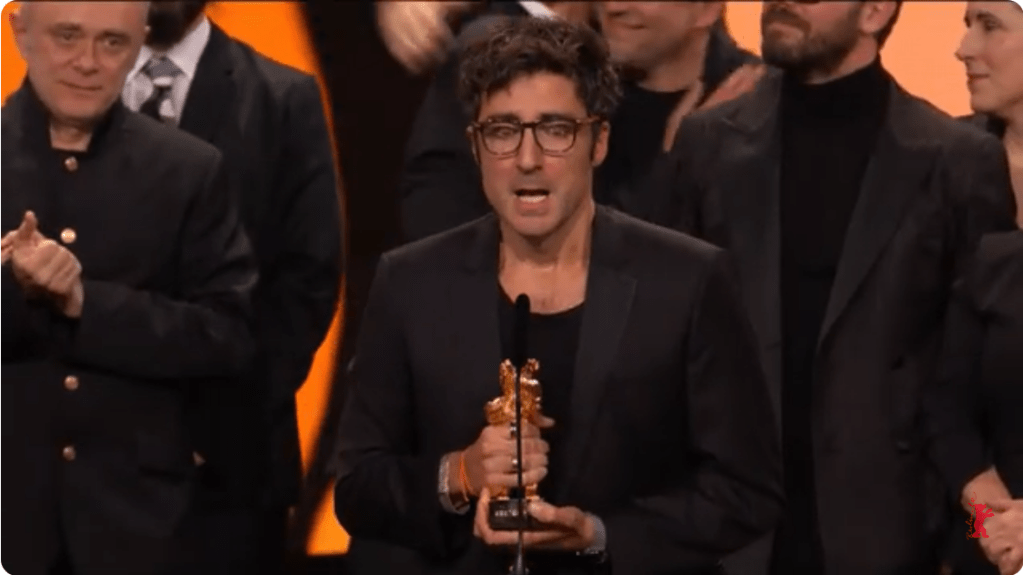
(Director İlker Çatak accepting Berlinale’s Golden Bear award for his film “Gelbe Briefe”)
By Michael Roddy
The raucous political debate over the Israeli-Gaza conflict and the rise of authoritarianism that has roiled the Berlinale Film Festival since its opening took over the stage for the closing ceremony on Saturday night where the winning films were announced.
Abdallah Alkhatib, who won the best documentary prize for “Chronicles From a Siege”, brought a Palestinian flag on stage while Lebanese director Marie-Rose Osta, whose “Someday a Child” won the Golden Bear for best short film, denounced Israeli bombings of children in Lebanon and Gaza.
“In reality children in Gaza, in all of Palestine, and in my Lebanon do not have superpowers to protect them from Israeli bombs,” Osta said to sustained applause in the Berlinale Palaste where the awards ceremony is held.
Tricia Tuttle, the festival’s American director, acknowledged in an opening statement that tensions during the 11-day festival, which featured a strong lineup of almost 300 films, had run high.
“This Berlinale has taken place in a world that feels raw and fractured. Many people arrived carrying grief, anger and urgency about what is happening far beyond these cinema walls. Those feelings are real. They belong in our community. We hear them,” she said.
“We have also been publicly challenged this year. That comes with being a visible cultural institution in a polarised moment.
“Criticism is part of democracy. So is disagreement. We respect people speaking out, even when we do not agree with every claim that is made about us.”
Much of the anger focused at the festival erupted after the German director Wim Wenders, president of the international jury that awards the main prizes, said at an opening press conference that “movies can change the world” but “not in a political way”.
This was seen as being tone deaf at a time when right-wing parties are on the rise in Europe, Donald Trump has changed America’s relations with the world and the Israeli-Gaza conflict remains a gaping wound.
There was at least a tacit acknowledgment that films can indeed be political in the winners of the festival’s number one and number two prizes.
The Turkish-German film “Gelbe Briefe” (Yellow Letters), directed by İlker Çatak (The Teachers Lounge), which got the top Golden Bear prize, is about the downfall of a successful academic and his actor wife when they fail to show sufficient deference to a powerful government minister.
The festival’s second Silver Bear Grand Jury prize went to the Turkish-Kurdish film “Kurtuluş” (Salvation), directed by Emin Alper, about a community in rural Turkey that descends into bloody clan rivalry.
Çatak said his film, which is set in authoritarian Turkey but was filmed in Germany with no attempt at disguise, was intended as a warning about the perils of authoritarian rule anywhere and that rather than artists and journalists feuding with each other, they should focus on the more serious threat.
“We are not enemies, we are allies,” he said. “It’s out there, it’s the autocrats, it’s the right-wing parties, it’s the nihilists of our time trying to come to power and destroy our way of living.
“Let’s not fight each other, let’s fight them.”
Alper, whose film Wenders praised for having a universal message despite being filmed in a remote part of Turkey, said he wanted to use the award to show Palestinians, Kurds, jailed Turkish opposition figures and others that their voices are being heard.
“The least we can do here is break the silence, and remind them they are not really alone,” Alper said.
“The Palestinians, living and dying in the most terrible conditions, you are not alone…The people of Iran, suffering under tyranny, you are not alone,” he said to loud applause.
“Queen at Sea”, an intimate and unflinching examination of an elderly couple living with severe dementia, won the third highest Silver Bear Jury Prize for its American director, Lance Hammer.
It also won a joint Silver Bear Best Supporting Performance for veteran British actors Tom Courtenay and Anna Calder-Marshall, who play the elderly couple. Accepting the award, Courtenay joked that if he and Calder-Marshall are asked again to play an elderly couple, he’d like to be the one with dementia so he’d have fewer lines to learn.
Other main competition awards were as follows:
SILVER BEAR FOR BEST DIRECTOR: Grant Gee for “Everyone Digs Bill Evans”
SILVER BEAR FOR BEST PERFORMANCE: Sandra Hüller for “Rose”
SILVER BEAR FOR BEST SCREENPLAY: Geneviève Dulude-de Celles for “Nina Roza”
SILVER BEAR FOR OUTSTANDING ARTISTIC CONTRIBUTION: “Yo (Love Is a Rebellious Bird)”, directed by Anna Fitch
 Irish Arts News