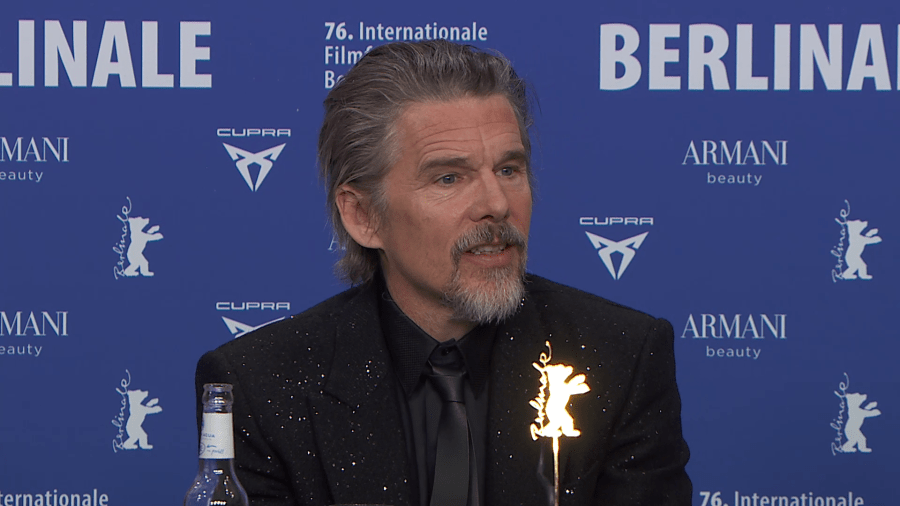
(Ethan Hawke, a star of “The Weight”, speaks at a Berlinale press conference on Tuesday, Feb. 17)
By Michael Roddy
Pretty much since the minute the Berlinale film festival opened on Feb. 12, the war in Gaza has been a hot topic at news conferences where the actors, directors and crew show up to talk about their films, but are being pressed as well about their views on the conflict.
The Berlinale, where almost 300 films are being screened and the top Golden Bear prize will be awarded on Saturday night, is famously political, but not usually as heated as this.
The die was cast on the festival’s first day when German director Wim Wenders, fielding questions about Gaza and asked if films can affect political change, said that “movies can change the world” but “not in a political way”.
“We have to stay out of politics, because if we make movies that are decidedly political, we enter the field of politics,“ he said, adding: “We are the counterweight to politics.”
That prompted an immediate response from Booker-prize-winning author Arundhati Roy, who called Wenders’s statement “unconscionable” and pulled out of a planned appearance at the Berlinale for the showing of a restored version of one of her films.
This was followed by an open letter, released on Feb 17, which now has more than 100 signatories, including Tilda Swinton, Javier Bardem, Mark Ruffalo and Ken Loach, condemning what it claimed was the festival’s “silence” on the conflict in Gaza and the “censoring” of artists who have spoken out.
Tricia Tuttle, the festival’s American director, felt compelled to respond.
“People have called for free speech at the Berlinale. Free speech is happening at the Berlinale,” Tuttle said in a statement released on Saturday. “But increasingly, filmmakers are expected to answer any question put to them.
“They are criticised if they do not answer. They are criticised if they answer and we do not like what they say. They are criticised if they cannot compress complex thoughts into a brief sound bite when a microphone is placed in front of them when they thought they were speaking about something else.”
The statement did little to quell the controversy. One of the people leading the charge has been German podcaster Tilo Jung, 40, who accused the festival of “shooting the messenger” who brings the bad news.
“These are difficult times when it comes to democracy in the West,” Jung told Irish Arts News in an interview on Friday. “We are seeing that fascism is on the rise. Many fascism scholars consider the Trump administration to be a fascist administration.”
“You can think about whatever you want, but fascism is the enemy of artistic freedom. So I think especially Hollywood artists have to at least be asked what their stance is when it comes to speaking out against fascism and for taking a stand for artistic freedom, which is under threat.”
One of the Hollywood actors who was asked, and gave an answer, was Ethan Hawke, appearing in Berlin as the star of “The Weight”, set in gold-mining times in the American west.
“Awright,” Hawke said, when questioned at a news conference on Tuesday about Gaza, adding: “The last place you probably want to look for advice in your spiritual counsel is a bunch of jet-lagged, drunk artists talking about their film. That said, I love the movies and I believe in the power of cinema.”
American actor Neil Patrick, asked at a news conference for the film “Sunny Dancer” if movies could help fight the rise of fascism, wasn’t going there. “In a strangely algorithmic and divided world right now, as an artist, I’m interested in doing things that are apolitical,” he said.
İlker Çatak, the German director of Turkish descent whose “Gelbe Briefe” (Yellow Letters) is itself a highly political film about academic and artistic repression in Turkey, saw both sides of the coin.
“On the one hand, I absolutely feel the solidarity, and you always want to be in solidarity with people in emergencies,” he said.
“On the other hand we live in shameless times, and I could, you know, put myself in fire on the street and put some fuel on on me and our politicians wouldn’t change things.
“So boycotting a festival seems questionable to me to at least.”
 Irish Arts News