By Michael Roddy
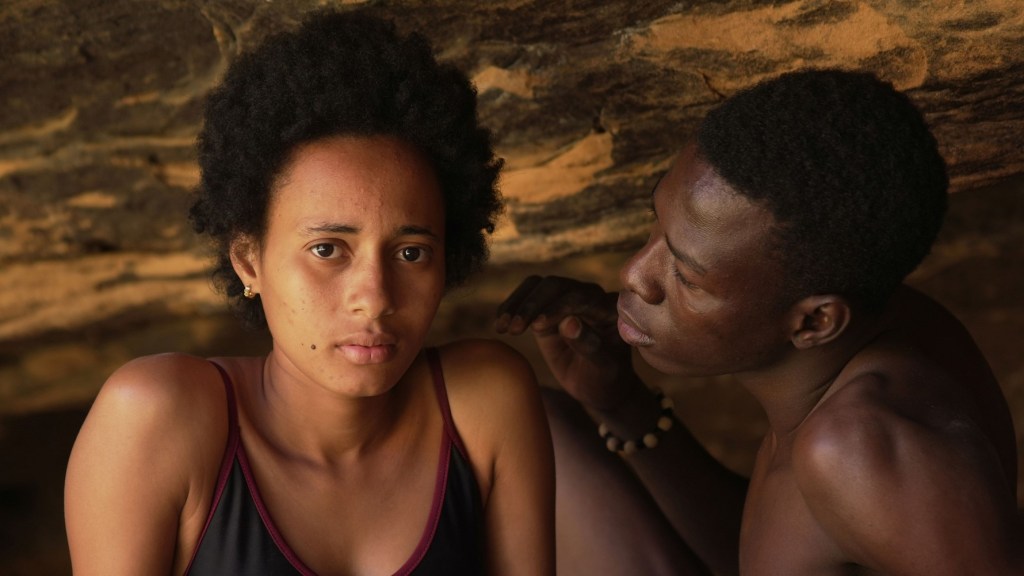
Near the beginning of the Chadian Berlinale competition film “Soumsoum, la nuit des astres” (Soumsoum, night of the stars) 17-year-old Kellou (Maïmouna Miawama) has walked from her village to an area of spectacular rock formations and a pellucid swimming pond where she has a terrifying vision of a half dozen zombie-like men stalking her.
No harm comes of it, but it is the first of several visions that will unnerve her and make her wonder if people calling her a “blood child”, because her mother died in childbirth, makes her different, and possibly evil.
The only one who can advise her is the town’s former midwife Aya (Achouackh Abakar Souleymane) but she has been branded an outcast and is shunned as a witch following the deaths of a half dozen infants.
The taboo is so restrictive that Aya cannot get help from the dispensary for a chronic cough that suggests advanced tuberculosis. Kellou’s father Garba (Ériq Ebouaney) tells her to stay away from Aya, who literally is a child of the stars. She was conceived on “Soumsoum, the night of the stars” when masked men and women danced and had sex without knowing who was whom. Nine months later, the infant took the mother’s name, but no patrilineal identity.
This is the complex world in which veteran Chadian director Mahamat-Saleh Haroun has set his tale which pits women, chief among them Kellou and Aya, trying to respect a tight bond between nature and humans, with a patriarchy that sticks to tradition, no matter what.
More than once in the film it is said that if nature is not respected, there will be consequences.
One of those disasters is heard on the opening soundtrack as a rainstorm that Aya says began at 10 a.m. on Sept 11, 2024 and lasted more than 24 hours destroyed much of the village through flooding.
Her visions tell her that more of the same is in store unless the villagers recognise the interconnectivity of all things.
“Yes, it’s important for me to work on this connection, this tie, that really underlies the whole beauty of the world, listening to the elements of nature,” Haroun told a news conference.
“I don’t talk about the natural world per se, I don’t want to be reactionary, nor do I want to cling to the past — the world is moving forward.
“So I’m not saying that we ought to go back to bygone days. But I think that we listen to the nature of the world. Silence, communion with nature, that’s something that is absolutely vital.”
Aya’s eventual death, which is broadcast from the moment we meet her, brings out the worst in the village menfolk. They do not want her body to be washed or buried, though this is the time-honoured custom, and insist instead that she be burned and her ashes scattered — so the village can be cleansed of her sorcery.
Haroun said the world he depicts in rural Chad is a fictional environment, and that the film is in no way ethnographic. A patriarchy that would insist on such punishments exists pretty much everywhere, he said, noting that in Europe witches were burned at the stake.
Kellou’s heroic effort to assure that Aya receives the respect she is due in death helps her in the end to conquer her own demons in this thought-provoking, beautifully acted film that despite its setting in the desert in Chad, has a universal message.
 Irish Arts News