By Michael Roddy
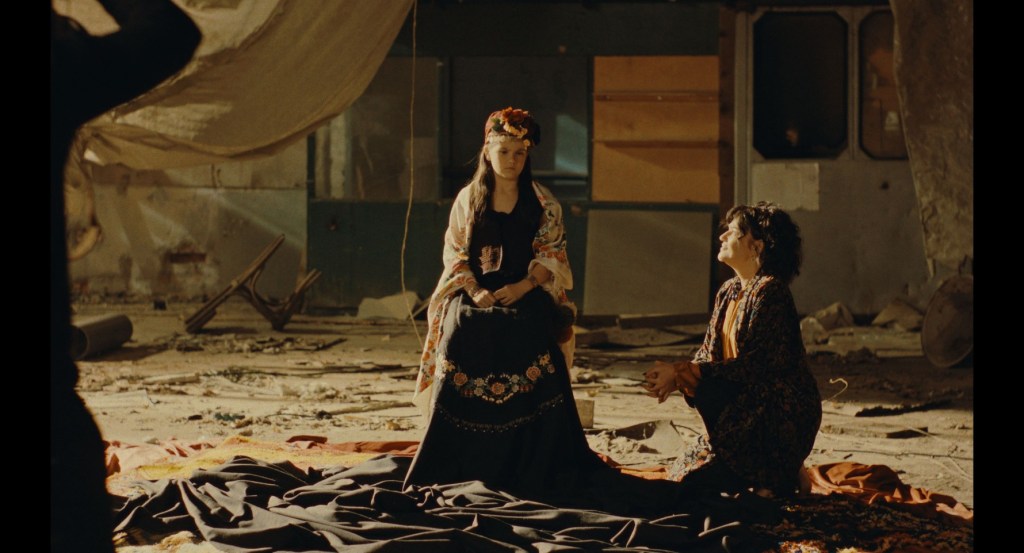
Art expert Mihail (veteran Bulgarian stage director Galin Stoev, in fine form) works in Montreal for collector Christophe (Christian Bégin) who has become obsessed, through seeing online videos, with an eight-year-old supposed art prodigy in rural Bulgaria named Nina (twins Ekaterina and Sofia Stanina).
If the girl is who she is made out to be, Christophe wants to get in early collecting her work so that he can make a killing later and he figures that Mihail, who was born in Bulgaria, is the very person to advise him.
So far, so capitalism as advertised in young Québécoise-Canadian director Geneviève Dulude-de Celles’s Berlinale competition film “Nina Roza”, which had its premiere at the Berlinale on Monday and for which she also wrote the screenplay. But this beautifully made and acted film takes some unexpected turns, which is why it is generating a positive vibe at the festival.
Mihail, who left Bulgaria almost three decades ago, fled what he saw as grinding poverty and hopelessness under the communist regime and although times have changed, and he has family there, he’s never been back. He doesn’t want to go back, either, but he digs his own grave by telling Christophe that you couldn’t trust anyone in Bulgaria to tell you what’s what without seeing for yourself.
Plus his daughter Rose (Michelle Tzontchev), who was born in Bulgaria but who Mihail took with him to Canada when her mother contracted a fatal illness, is going through a rough patch in her marriage. She has returned home to her dad, at least temporarily, and is amusing herself with some of the Bulgarian artefacts around his house. One of them is an anthem-like Bulgarian pop tune which she recalls her mother playing for her but when she puts it on Mihail’s stereo, he rages that it is communist propaganda about the scenic beauties of Bulgaria and turns it off.
In short order, Mihail is on a plane to Bulgaria where he not only has to figure out if young Nina is on the up and up but also face the skeletons in the closet of his Bulgarian past. A scene in which he shows up unannounced at his sister’s house is one of the film’s most dramatic, with the sister Svetlana (Svetlana Yancheva) throwing three decades of resentment in Mihail’s face.
“Who told you I wanted to see you?” she rages, but eventually she and the rest of her family, including her husband who from the start welcomed Mihail with open arms, relents. “You’re my only brother,” she says, revealing that she has kept a box of souvenirs from his childhood.
Mihail also discovers that the young child Nina, whose art has created such a stir, is facing a similar uprooting to what he did to his daughter: Italian art dealer Giulia (Chiara Caselli) has made a contract with Nina’s mother to buy and represent her art, and wants her to go to a prestigious Italian art school to develop her talent. Nina, in protest, is refusing to paint anymore, although unbeknownst to her mother and Giulia, who Nina calls “the witch”, she has taken refuge in a shepherd’s hut on a promontory above the village and shows Mihail the paintings she has made there.
“I think what I wanted to represent in the film was that Mihail has made a choice, and he’s well aware of that choice, but that choice is associated with certain sacrifices. There’s an element of grief and mourning in that as well,” Dulude-de Celles said at a press conference
“And you also see an element of this in Nina as well. The parents have all kinds of reasons for migrating, but children, Nina’s eight, for example, might have difficulty in understanding why they’re really uprooted, taken away from what they know, where they belong, their friends, their country.”
“The mother also wants this for her daughter. And I wanted to create, I figure it’s not Machiavellian or anything, it’s a cooperation with the mother after all. But what’s difficult to grasp, I think, is the viewpoint of the child, what it would cost them. I think the memories that the child will keep years later as well.”
 Irish Arts News