By Michael Roddy
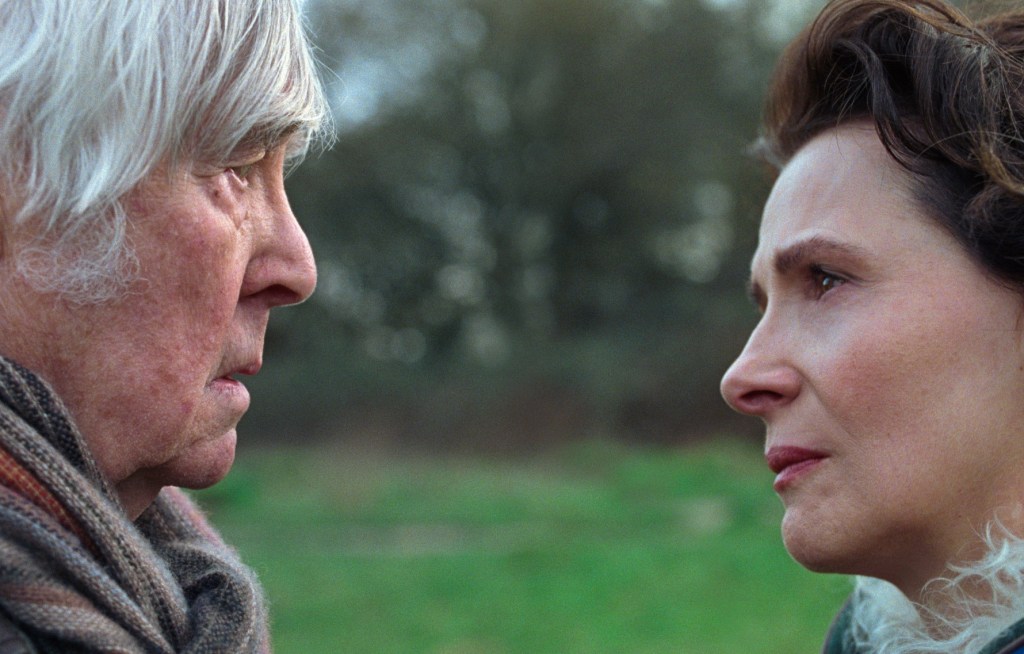
Teenaged Sara (Florence Hunt, winsome) has a question for her mother Amanda (Juliette Binoche, superb) after they walk in on octogenerian Martin (Tom Courtenay, ditto) having sex with his dementia-stricken wife, Amanda’s mom Leslie (Anne Calder-Marshall, convincing) in the elderly couple’s north London townhouse.
How, at his age, does he perform the sex act, Sara asks? “Viagra,” says her mom, who is outraged by Martin doing this despite having been told many times that even though Leslie is his wife, she is in no mental condition to give consent. This time Amanda has had enough and calls the police, which leads to a cascade of unintended consequences she will come to sorely regret.
Dementia, Alzheimer’s, the general mental degradation associated with old age are big topics in today’s ageing societies. American director and screenwriter Lance Hammer has nailed it in his feature film “Queen at Sea”, which had its world premiere on Tuesday at the Berlinale and is in competition for the festival’s top prize, to be awarded on Saturday.
“It is extraordinary to fully focus on people with dementia and go right inside of them,” Courtenay said at a news conference. He and Calder-Marshall, it was pointed out during introductions, were paired as Hamlet and Ophelia in a 1968 stage production.
Hammer, whose most recent previous film was “Ballast” (2008), said he was inspired to make the film after hearing multiple stories from friends about parents with dementia, and reading news reports. “It was telling me like, I have to pay attention to this,” he said, adding that the screenplay was based on multiple accounts.
He said the procedures and protocols seen in the film, when the police, social workers and medical workers become involved, had all been carefully researched with professionals. A woman caring for Leslie in the final scenes is an actual carer, he said.
What Amanda’s intervention is intended to show is that while Martin may think he is doing the best for Leslie — he even claims that she initiates the sex — he is too close to the situation to judge properly.
“Amanda never questions the love,” Hammer said. “She sees what Martin cannot see because it’s happening so gradually.”
Staircases — a known hazard for older people — are a big feature. The opening shot shows Martin and Leslie, who before her mental decline was a talented artist, struggling up one of the endless flights of concrete steps from the London Underground. They are locked arm in arm, he with a cane in his left hand, she holding for dear life to the railing with her right. At the top, he embraces her around her shoulders. Despite her collapse, he still deeply loves her.
Going for walks is part of the calming lifestyle Martin and Leslie live. He plays his classical vinyl LPs of Bach, Beethoven and Schumann, cuts up and feeds her food to her and ends the meal with her favourite treat of baklava.
But all is not right in this little oasis. For one, the house is on three levels, with the bedroom at the top and access via endless flights of stairs, with rickety banisters. Plus Amanda, who has legal custody for her mom, and gets to decide where she will live and in what conditions, no longer trusts Martin.
The call to the police produces quick results. Two constables arrive to assess the situation, the bedroom where the sex act occurred is sealed off, a forensics team in hazmat clothing removes the bed covers and Martin is arrested for questioning. He will not necessarily be charged, one of the constables says, but a social worker will have to investigate and decide what is best for Leslie. The disruption is total.
Martin is indeed not arrested but a move for Leslie, at least temporarily, to a care facility for dementia patients is arranged. This turns out to be more of a fiasco than keeping her at home would have been, for reasons it would be unfair to divulge.
But there is an interesting contrast made between the couple’s quiet home with its Bach and staircases and the care facility with its lift to take patients to rooms on upper levels and its activity room where the residents are banging on percussion instruments to the tune of “O Susannah” played on an upright piano.
Hammer’s film focusing on the rising demands for aged care, and the special needs of dementia patients, is as timely as can be. It also leads to a cautionary ending that shows graphically that this kind of care is not something someone can provide alone. When the problems arise, call a pro.
And the title, “Queen at Sea”? Hammer said it was an expression he had heard in England to the effect that when a queen boards one of her galleons of war, it means the kingdom is in trouble. Possibly apocryphal, certainly appropriate.
 Irish Arts News