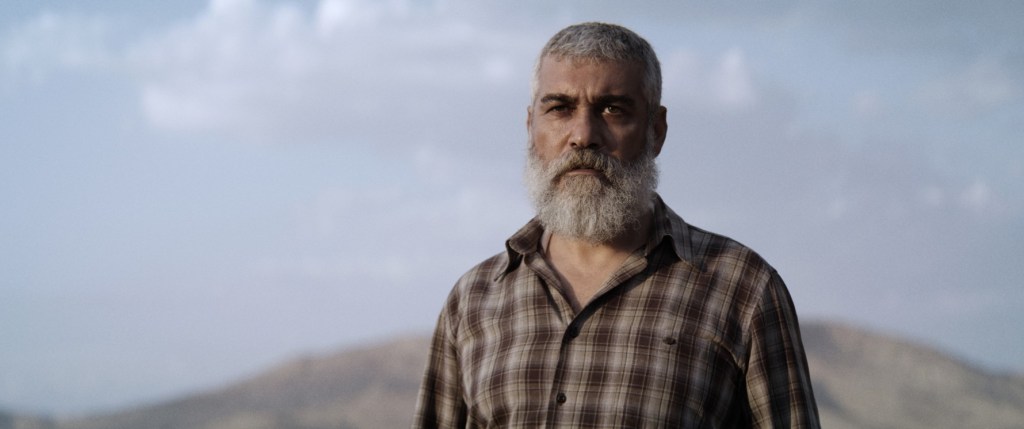
(Caner Cindoruk as vision-possessed Mesut in Kurtuluş)
By Michael Roddy
Clan rivalries spiral fatally out of control in a farming and shepherding village in southeastern Turkey that could be any place where tensions between feuding groups end in violence in the Turkish-Kurdish film “Kurtuluş” (Salvation), which had its premiere at the Berlinale on Sunday.
In competition for the film festival’s top Golden Bear prize, the powerful feature film by veteran Turkish director Emin Alper shows what can happen when people reject a leader urging restraint for another who has mystical visions, preaches zero tolerance of “the other” and thinks that complete eradication of supposed foes is the only way to end cycles of violence.
“I just wanted to create a person and a society which believes that they have a mission, that they have a mission to save their nation or something like that,” Alper told a news conference.
“Because we are living in such conditions that people are choosing, people are making their choice for the unstable erratic leaders around the world…What I want to emphasise is that any time any society can choose such crazy leaders which drag them to catastrophe.”
The film was inspired by a rivalry between Kurdish clans in Turkey’s southeastern Mardin Province that escalated into an attack on a wedding party that killed 44 people in 2009. Alper said such violence is not unique to Mardin or Turkey, and mentioned in that context the Israel-Gaza strife.
“The history of mankind is full of such kind of atrocities, that’s why I’m attracted by this story and I wanted to create from this very local issue a story which is a global and historical relevance,” he said.
His film pits two Kurdish clans, the Hazirans living in an upper village, and the Bezaris living in a detached lower village, in rivalry for arable land and grazing areas. The fact that there are supposed “terrorists” operating in the area, and that the Hazirans are armed as part of a militia to fight them, while the Bezaris, who’ve been moving back from city life, are not yet in that militia, adds fuel to the fire.
There is also a barely repressed sibling rivalry between brothers Mesut (Caner Cindoruk) and Ferit (Feyyaz Duman) that eventually explodes into the open and has its roots in the brothers’ respected sheikh father having bestowed his religious authority on Ferit. Mesut is wealthy by village standards but he resents his brother and begins to have visions of ghost-like people moving through his house and dreams in which his dead father speaks to him. And what his father is telling him is that the Hazirans have to get rid of the Bezaris or the rival clan will get rid of them.
Ferit has been trying to mediate and keep tensions from exploding out of control but Mesut prods other villagers to join him in accusing Ferit of profiting from his ties to the Bezaris. Mesut even takes up residence in a cave where the other villagers start coming to receive his wisdom. Eventually, Ferit is thrown out of the mosque, Mesut takes over and the Hazirans go on the warpath, which Mesut says is the only way they can assure their “salvation”.
A film with subtitled dialogue in Turkish and Kurdish, and taking time to show in detail the way people make a living and interact in a form of village life that hasn’t much changed in millennia, let alone centuries, is a slow burn but when it gets to the boil this film is scalding.
Cindoruk is especially powerful as the possessed Mesut who thinks that twins are the devil’s work, has a dream where he sees his pregnant wife having intercourse with an invisible rapist, and finds parables in the rivalry of Cain and Abel in the relations between the two clans.
As one questioner put it at the press conference, the atmosphere and setting of the film, and the final reckoning, seem almost biblical. And there’s plenty of gore and bloodshed in the Bible.
 Irish Arts News