By Michael Roddy
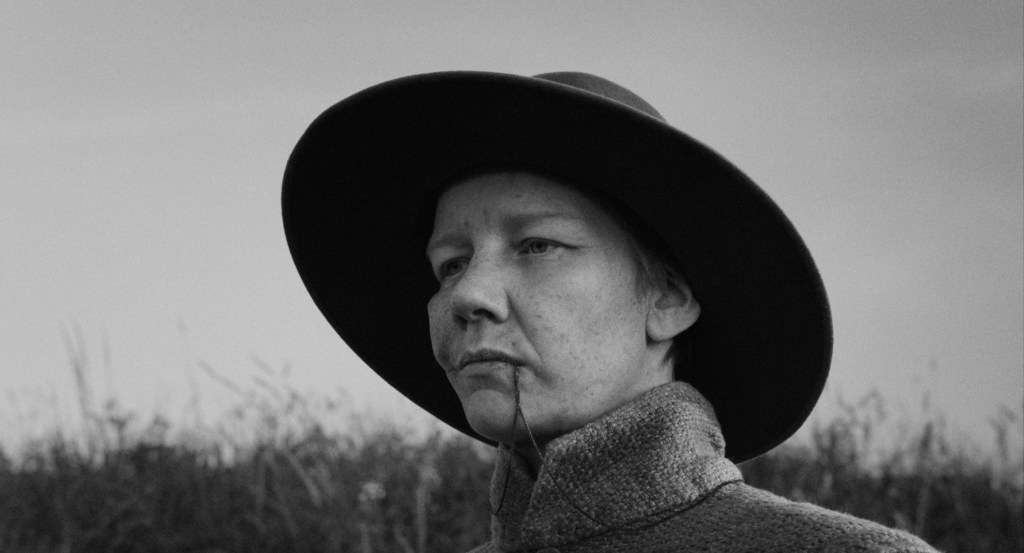
Sandra Hüller (“Anatomy of a Fall”, “Toni Erdmann”) gives a textbook performance of subtlety and craft as the titular character in the Berlinale competition film “Rose”, based on the true story of a woman who dressed and passed as a man not in the modern-day metrosexual world, but in the strictly gendered 17th century.
Precision-tuned by Austrian director Markus Schleinzer, “Rose” had its premiere on Sunday at the Berlinale and would now be considered a strong contender for the festival’s top Golden Bear, to be awarded on Saturday.
The film opens with shots of barren, blackened fields, evoking the battlefields in which Rose, disguised as a man, fought and was severely wounded in the 30 Years War. She wears the stub of the bullet that split open her cheek on a lanyard around her neck and occasionally chews on the bullet, at moments of tension.
A fellow fighter who died in the conflict left behind the deed to a property in an isolated Protestant community in rural Germany. Rose, maintaining her disguise, shows up to claim she is the heir. She knows just enough details about the property’s history that she is able to quell the villagers’ misgivings and suspicions — at least for the moment
Within a year she has brought the remote farm back from ruin to thriving and is thinking of ways to increase her earnings. She has her eye on using a stream owned by another farmer who had wanted to get her land. He rejects selling the stream but is agreeable to letting her use it on one condition: he is a widower and he wants Rose to take one of his five daughters to wife.
Rose — improbably, rashly, unwillingly — we’ll never know — agrees.
And from that point the film veers into territory that would be bizarre even today. German actress Caro Brau plays the young wife Suzanna who, in the absence of a mother who could have told her what’s what, meekly agrees to Rose’s demand that they sleep separately — so, Rose says, that Susana’s purity can remain intact.
That arrangement works for awhile, but eventually, in a small, church-going rural community, the women begin to talk about the lack of an offspring. Rose, who for years has used a hollowed out horn device as a fake penis, now comes up with a strap-on male member that she uses to perform the sex act. Suzanna, not knowing the difference, takes it that she has conceived because the day after she is deflowered, a butterfly lands on her belly. And when the gestation period should be more or less up, Rose lays her hands on a suitably young baby boy, from sources unknown and never clarified.
Secrets will out, however, but it would be unfair to say how Rose is finally exposed for who she really is. Nor would it be fair to say how the story ends, but if you consider the period, and how shocked, angered and unsettled people of that time would have been, it’s not hard to figure that the couple go on trial and the trial goes badly — for Suzanna and for Rose.
What “Rose” is not, however, is what the Berlinale programme guide has labeled it, namely as “Queer” and “Queer Period Pieces”. At no time in this gem of a movie does Hüller display any hint that she fancies Suzanna sexually. Instead, she explains to Suzanna, after she is in on the secret, that having grown up in an orphanage, and seen the disparity between how men and women fared in the world, she figured her prospects were better in pants. Suzanna, facing the prospect of being married off again to someone she doesn’t know and might treat her badly, casts her lot with Rose.
“She says it really very clearly in the trial that she has no desire to be a man,” Hüller said. “She really uses this drag as a disguise to live in safety and to have a life of her own.
“If it’s a lie I don’t know and honestly I don’t care. But I played a woman who is pretending to be a man, I didn’t play a man.”
 Irish Arts News