By Michael Roddy
First time Finnish mother Saga (Seidi Haarla) has a problem, and it’s not just that her British husband Jon (Rupert Grint, of “Harry Potter” fame) is alien to the local culture or that her grandmother, whose wreck of a house deep in the Finnish woods they’ve renovated and moved into, warned before her death of mysterious goings on in the forest.
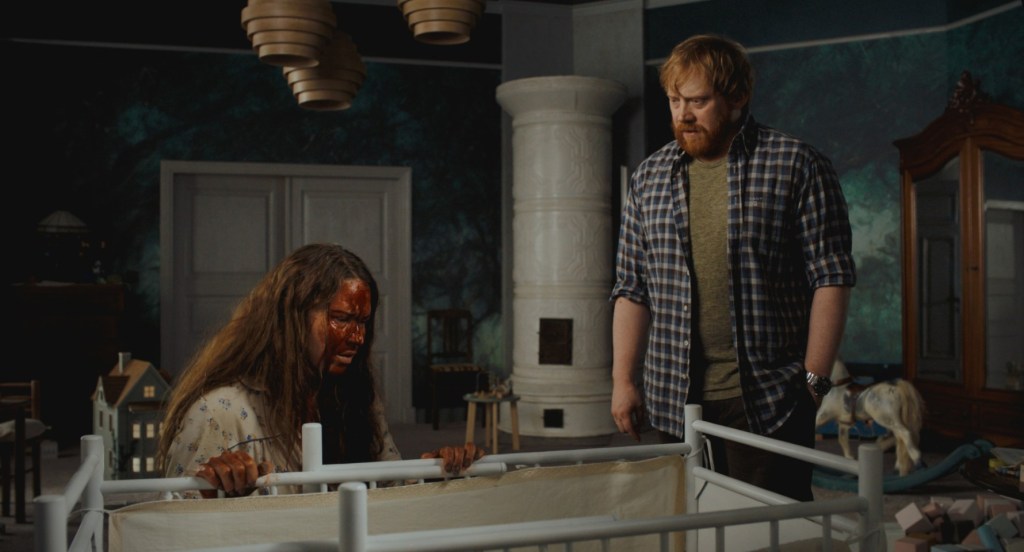
No. The real problem manifests in the fact that Saga’s breasts are bloodied raw by breastfeeding her heavily body-haired newborn baby boy, who howls almost non-stop and has unusually long and sharp fingernails. Plus he’s preternaturally strong.
She and Jon have agreed to call him Christian, after Jon’s minister father, but when a breeze sweeps in from the forest during a baby-naming party with friends, it pushes a sunscreen flap over the screaming baby’s buggy and he goes silent. Something clicks in Saga and when it comes to naming the child she blurts out, to Jon’s suprise and annoyance, that the baby will be called “Kuuru”.
In Finnish that roughly means “to hide”, perhaps in a dark place, which is what this odd baby prefers. But in young Finnish director Hanna Bergholm’s “Yön Lapsi” (Nightborn), a main competition film at the Berlinale, and only her second feature film, very little else is hidden.
This may well be the most troubling and gruesome take on the newborn-from-hell trope since Roman Polanski’s “Rosemary’s Baby” way back in 1968, with the difference that Bergholm’s film is awash in blood but laugh-out-loud funny — as long as you keep telling yourself it’s stage blood.
Bergholm acknowledged the Polanski adjacency. “We kind of joked that this film starts where ‘Rosemary’s Baby’ ends, but of course there’s no Satan,” she told a news conference.
But there is a very big, dark and possibly malevolent forest right beside the house and, as the plot develops, inside as well.
One of the main, and funniest, in a cringy way, themes of the film, which had its festival premiere on Saturday, is the utter disconnect between what the nurses. who tell Saga she has given birth to a healthy baby boy, and therapists, who tell her she needs to show more empathy, and what she sees and knows herself. She almost immediately takes to calling the baby “it”, and eventually, as its taste for raw blood becomes manifest, “monster”, much to Jon’s dismay.
“It’s sucking me dry,” she tells him in one of the frequent interchanges between them in which he maintains she is failing to develop a bond with the baby and she says she thinks that’s impossible.
Actually it’s Jon’s visiting parents who hit the nail on the head when Jon’s mother (Rebecca Lacey) says she’s been reading up on Finland and remarks on the legend that in some forests there are still trolls. Little does she know how true that is, or how closely related she is to one.
Jon’s father Christian (John Thomson) performs a baptism in the living room of the forest house, complete with holy water. The audience fully expects steam to arise when the water is poured on baby Kuuru’s head, but it all happens with nary a whimper. That’s one to puzzle over, in this encounter between pagan and christian ways, but little else is left to the imagination.
When Saga starts feeding Kuuru bottles filled with raw cow’s blood and moves on to solid food in the form of big chunks of raw meat there’s little guesswork left.
The forest is, of course, a starring character and this grove of evil is vividly imagined. Early on, when Saga and Jon are visiting the abandoned wreck for the first time, they make love on a bed of sinister looking moss swarming with beetles. Nearby is a tree trunk that looks like a ghoul’s face and another that resembles nothing so much as a huge wooden, bark-covered breast. They should have read the warning signs. Instead they committed the original sin in an evil glade, and pay the price.
The film is wonderfully acted, especially by Seidi Haarla as the suffering, perplexed Saga and Grint as, let’s face it, the dickhead who doesn’t get it until it’s too late. The scene of him trying to feed Kuuru some sort of pear compote with a metal spoon — pretending the spoon is an airplane delivering goodies — when Kuuru as a child of the forest is allergic to metal, is hilarious. Saga puts an end to the farce by plumping down a big slab of raw meat on the highchair, which Kuuru avidly devours.
Bergholm acknowledged that a lot of stage blood went into the making of this film, and some of the cast and crew said there were different types and levels of sweetness. But she said she wanted to show also how blood is a deeply human part of our nature, and not just a way of signifying death in a war film.
“I feel that it gives me more space to be a human to be reminded of blood and the insights of who we really are doing this,” Bergholm said.
This is a clever and though-provoking addition to the horror genre, with a wonderful soundtrack by Finnish composer and cellist Eicca Toppinen. An oddly dark cello tone in the opening moments of the score lets you know this visit to the woods is going to be no picnic.
 Irish Arts News