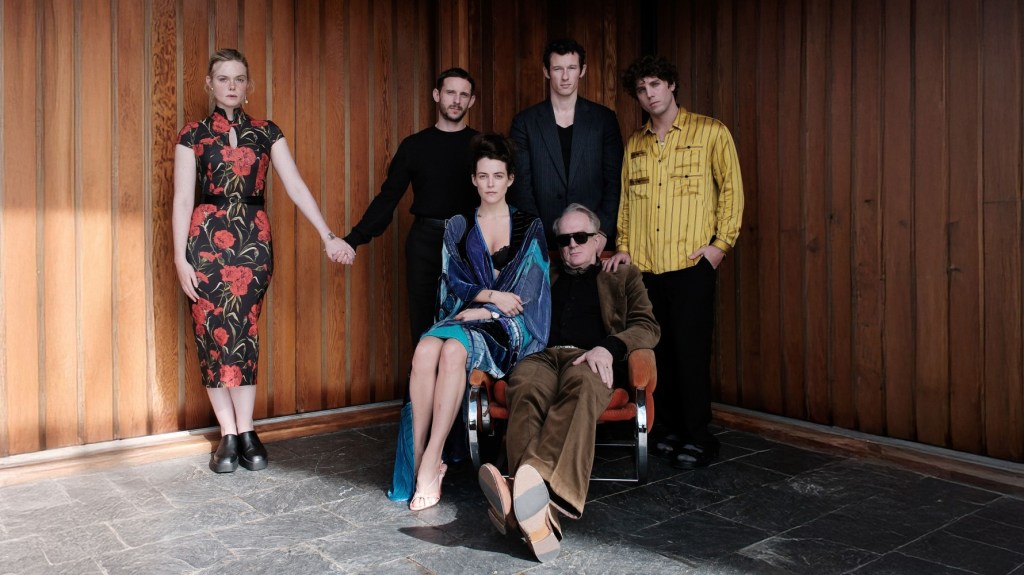
By Michael Roddy
In the Berlinale competition film “Rosebush Pruning”, by Brazilian director Karim Aïnouz (The Invisible Life of Eurídice Gusmão), the first member we meet of a stinking rich and utterly loathesome American family, who’ve transplanted themselves to obscene levels of luxury in Spain, is son Edward (Callum Turner).
He is on a busy boulevard carelessly and aggressively trying to hitch a ride. When he moves too close to traffic and a Spanish couple’s side mirror hits and knocks him over, Edward casually gets them to drive him where he wants to go.
In a voiceover he says that because he and his two brothers and one sister are ridiculously rich, he never reads or writes, nor did he learn how to drive, which is why he hitchhikes or takes taxis everywhere.
He also says that he is the creator of meaningless aphorisms which, because he is rich, some people think are profound. One of them goes: “When the banana falls down, it doesn’t matter, when the melon falls down, it’s all over.”
Edward’s only real passion in life, besides luxury fashion — especially Bottega, is admiring and pruning rose bushes. He has decided, without consulting any of his siblings, that it’s time to deal with his family like a rosebush. Hence: “Rosebush Pruning.”
If you can imagine episodes of “White Lotus” or “Succession” that all end in carnage then you have a notion of “Rosebush Pruning”. The script is by Greek screenwriter Efthimis Filippou, who worked with Yorgos Lanthimos on the 2015 absurdist black comedy “The Lobster” — in which people of a dystopian world who fail to find a mate become the animal of their choice.
Filippou was asked at a news conference on Saturday if his script referenced Greek tragedy, which he said had not been foremost in his mind. But he clearly was up on his Chekhov, introducing all the eventual murder weapons one by one before they are put to use. That this set includes a very large Andalusian horse and pack of wolves should give you an idea of what’s afoot.
The wolves enter the picture early as the only sister, Anna (Riley Keough) accepts delivery from a butcher of what looks like a large slab of meat wrapped in plastic but turns out to be a whole slaughtered sheep. She has it placed in the back of a car and while she isn’t looking the eldest brother, Jack (Jamie Bell), surreptitiously slits open the plastic and samples the fresh blood. Turns out Jack, who Edward thinks is the only sibling worth his salt, and whose voice he has learned to imitate as part of his plot, has a thing for blood — the animal’s, his girlfriend Emma’s (Elena Anaya) menstrual flow, you name it.
The whole family, including the blind patriarch played by Tracy Letts — “Succession’s” Logan Roy in pervert mode — bundle into the car with the sheep to head into the hills. A cross has been erected at a spot where it is said their mother was attacked and devoured by wolves — leaving not a trace behind (hint, hint, spoiler, spoiler — look on the cast list and see Pamela Anderson listed as the mother).
So there is no body underneath the statue of the mother, portrayed naked, which is a centrepiece in the family mansion. But there are wolves in the hills where the family deposits the sheep and they make quick work of it. The father says better to feed them than to have some other poor soul fall victim. Little does he know.
Jack, the eldest, is trying desperately to detach himself from the world of utter indolence and indulgence that is the life of his siblings and his father. He invokes the rights of patriarchy by insisting that his daughter Anna cook all the meals and demanding that Jack help him brush his teeth at night. That brushing comes with an extra service by Jack that you’ll have to see the film to find out.
Jack has hitched up with the pretty much penniless guitar student Emma, who, in this world of Rolex owners, wears a Swatch that doesn’t work. He’s helped her by renting an apartment, buying her a Bottega bag (yes), but when he brings her to meet his family over lunch all his blind father wants to know is how big are her breasts. Much to Emma’s embarrassment, this erupts in a family debate, with Jack saying they are average size bordering on large and Anna opining that they are small like hers, trending to smaller.
That Emma doesn’t pull up stakes immediately, and instead embarks on a luxury house-hunting tour with Jack, shows that no one is getting out of this vicious cycle where the haves have and the have nots have not — but want. Although some do get out of it, just not alive.
Asked at the news conference if the film was meant as a critique of widening economic disparity and rightward political shifts in the United States and elsewhere, Letts said he did not want to peg the film as political commentary.
“But one of the things that this movie gets at, I think, again, on the face of it, is that this extreme disparity in wealth breeds bad behaviour and, in fact, probably creates fascism,” he said. “So that is one of the things that this film gets at. I think it’s present on the face of it.”
 Irish Arts News