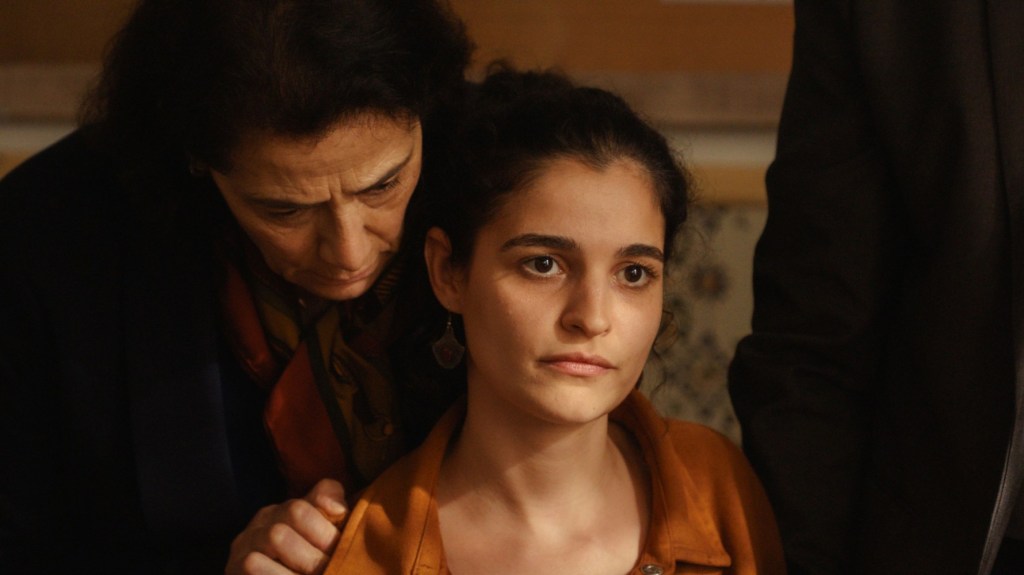
(Hiam Abbass as Wahida and Eya Bouteraa as her daughter Lilia in “A Voix Basse”)
By Michael Roddy
The cast and director of a Tunisian film that deals with a lesbian love affair said at the Berlinale on Friday they hoped “A Voix Basse” (In a Whisper) would help shift Western stereotypes about the Middle East — and help Tunisia overcome its strict censures on same-sex relations.
“We made the film with an enormous amount of sincerity,” director Leyla Bouzid said, adding that she was hopeful it would gain a wide audience even in Tunisia, where homosexual men can be jailed.
“It calls for tolerance. I believe that that is why the film is not provocative or argumentative,” she added.
Palestinian actress Hiam Abbass, who is well known to Western audiences for her roles in “Succession” and movies including “The Lemon Tree” and “Munich”, said she thought it was important for artists to speak out on social issues and to stand up against what she said were rising threats to democracy around the world.
“I think we live in a very dangerous period,” Abbass said. “…We’re all facing fascism in a very, very big way. And I think today, if we don’t, in our art, express our responsibility as artists of what we think of this world around us…I don’t think I’m really interested in that form of art today.”
“A Voix Basse”, which is competing for the festival’s top Golden Bear prize, is about the return to Tunisia after a long absence of Lilia (Eya Bouteraa) to attend her uncle’s funeral. Lilia has been telling her mother Wahida, played by Abbass, that the pressures of work prevent her from coming home. But we learn the real reason in the first few minutes when Lilia drops off her partner Alice (Marion Barbeau) at a seaside hotel a safe distance from the family home in the centre of Sousse.
Lilia knows that in the strictly heterosexual-coded world of Tunisia, her partnership with a woman will not go down well.
The twist that starts the plot rolling is that it turns out Lilia’s uncle, known by his nickname Daly, was himself a none-too-closeted gay man. The police have taken an interest in his death because when he was found dead in a public place, he was stark naked.
With the family reluctant to look too deeply into the matter, Lilia makes her own inquiries, which includes going with Alice to a gay bar where Sousse’s shunned gays socialise carefully amongst themselves. She finds out that Daly indeed had a much younger male lover, but when she tracks him down in a rural farming village he is too afraid to talk, except to say that someone very powerful whose name will never be revealed was implicated.
The movie was filmed in a townhouse belonging to members of Bouzid’s family and includes moving vignettes of the prayer singers who chant religious airs for Daly’s funeral and of the women of all generations who provide the hospitality for the male and female mourners.
All is going according to Lilia’s plan until Alice decides on her own to show up at the family home. Lilia is outraged and even though Alice protests that they’d agreed she should meet her family, it brings tensions to the boil.
Barbeau said her character is directly illustrative of the ignorance of Westerners about foreign cultures.
“She’s on the margins of a family, it’s a culture that she doesn’t know about and that she has fantasies about as well…She thinks that she knows things but in fact she has no idea at all,” Barbeau said. “She doesn’t grasp at all how serious the situation is. She doesn’t realise what she’s going to encounter when she gets to Tunisia.”
“Perhaps I could add a few words as well”, said director and actress Selma Baccar, who plays Abbass’s mother. “I live in Tunisia, and in fact, it really is time for humans to talk to each other as human beings, forgetting about colour, sexuality, religion. We’re all simply human beings.”
 Irish Arts News