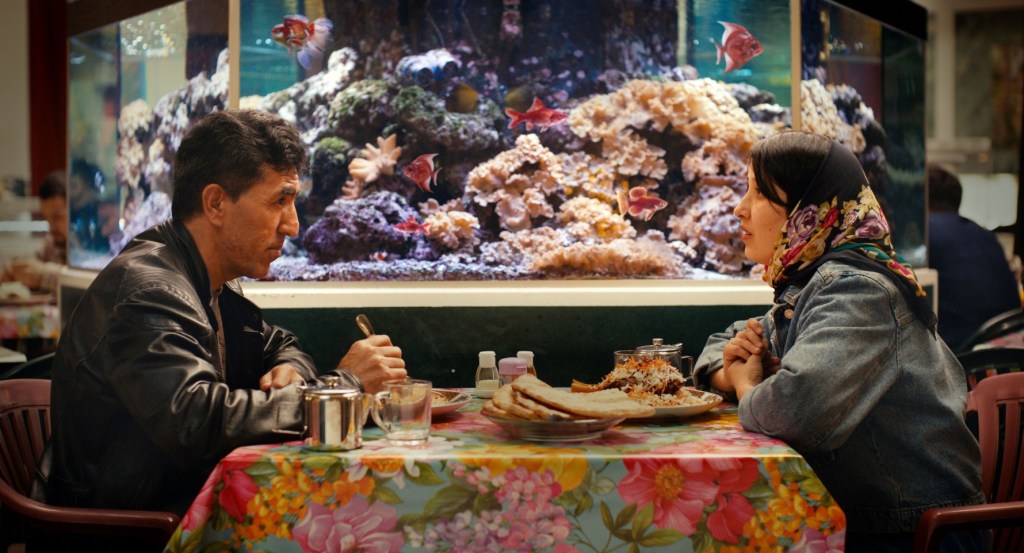
(Qodrat (Anwar Hashimi), left, dining with Naru (Shahrbanoo Sadat) in Sadat’s Kabul-based rom com at Berlinale)
By Michael Roddy
It’s Valentine’s Day in Kabul, in 2021, and ambitious news cameraperson Naru (Shahrbanoo Sadat) is hoping desperately to break through the glass ceiling of misogyny in Afghan society and get to cover some real news instead of doing camerawork for a women’s phone-in helpline show.
She seizes her chance when Kabul TV’s senior reporter, the much respected Qodrat (Anwar Hashimi), needs a cameraperson last minute to film an interview with someone involved in negotiations with the Taliban, which is resurgent despite the U.S. military presence. Naru promises the sceptical Qodrat that she “won’t do anything to mess this up” but that is without counting on the hardline Talibanist interviewee taking exception to her headcovering — she is wearing a scarf, but nothing more elaborate — and storming out of the room.
On the way back to the station, Qodrat takes his revenge by dumping Naru in a market street and instructing her to film some “vox pops” for Valentine’s Day. Naru turns the tables by getting Afghan women to confess to her on camera that their husbands have never said they love them. One of them even opines that in Aghanistan there are “no good men”. The interviews cause a sensation back at the station and even the begrudging Qodrat looks at Naru with new respect — and something more than a friendship begins.
So far, so much the boy meets girl, love is kindled, life is complicated plot of romcoms. Have I mentioned that Naru has a 5-year-old boy and is separated from her ne’er-do-well husband while Qodrat is 20 years older, married and is about to celebrate the birthday of one his daughters? This romcom, though, is told against the backdrop of the brutal oppression of women in Afghanistan — even though the comparatively enlightened interim rule of the U.S.-backed government gave women the right to get an education and enter previously taboo careers like Naru’s as a camerawoman. The main reader on the Kabul News is a woman, though she is made up with clothes, long fingernails and so much make up she looks like a chandelier.
But old customs die hard. Naru says she can’t ask her husband for a divorce because he will take away her son Liam (Liam Hussaini) and the authorities will let him do it. When Qodrat challenges this, she responds, “You don’t live in Afghanistan.” And any reforms that have been made may be — and were proven to be — short lived. The Taliban is retaking control of the provinces and the leadership in Kabul is refusing to acknowledge this, digging their heads as deep as possible in the sand.
It’s an interesting twist to the timeless story, and Sadat, who directed as well as playing the leading lady, has given a pointed hint at what’s to come — the Valentine’s Day is in February 2021. The United States announced shortly afterwards it was withdrawing its troops and by August the Taliban was in the streets of the capital. In the mass panic that ensued, Afghanis thronged the airport hoping to get on a flight to anywhere. Some clung to the wheels of taxiing airplanes, generating images that shocked the world.
In that crush to escape the Taliban, Qodrat and Naru’s fate is determined. Despite being set against the exotic — or perhaps the right word is “terrifying” — backdrop of Afghanistan and Kabul, the story unfolds fairly predictably. Qodrat’s deep reserve may make it difficult for viewers to engage with him. But without giving away too much, the ending sticks the landing. A hankie or two may be in order.
As for the authenticity of what is shown onscreen, some of it is news footage from the chaotic U.S. and allied withdrawal, but the film was shot in Germany. Sadat herself fled Kabul with members of her family in the aftermath of the Taliban’s victory. Her film speaks from experience.
Sadat told a news conference that she was in part motivated to make the film to show the world another side of Afghanistan. She said the self-assured, confident women she interviewed talking about their relationships with men were typical of Afghan women, who she said had learned to be tough to deal with the country’s entrenched patriarchy.
“In Afghanistan, we don’t have a film industry. Therefore, a lot of international filmmakers, when they make films about Afghanistan they kind of misrepresent Afghanistan because they do not know the country, and they do not know the people so much, so they’re just concentrating on the war…
“I wanted to make something that is more relevant to my everyday life, and I came up with a romantic, healthy idea.”
 Irish Arts News