Cheers of “Slava Ukraini” (Glory to Ukraine) rang out in the Berlinale Palast on Thursday at the world premiere of the brilliant but heart-rending documentary “Strichka chasu” (Timestamp), about the superhuman efforts Ukraine has made to keep schools open during 10 years of war with Russia.
Directed by Ukrainian documentary maker Kateryna Gornostai, the two-hour-long film entered in competition for the Berlinale’s main prize shows Ukrainian students attending classes in schools that have been partially blown up by Russian rockets, rushing from their lessons into air-raid shelters when the alert is sounded and taking classes over video links because their schools have been destroyed.
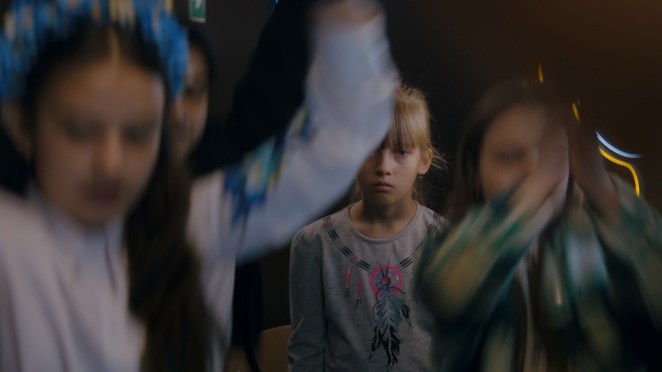
It also shows students, in the face of all the challenges, rehearsing dance steps for a graduation-day ceremony, sharing graduation-day dance videos over social media, and taking crucial exams with the instruction beforehand that they may have to leave mid-exam if the sirens sound.
Director Gornostai had just given birth and could not attend the press conference, but the film’s editor, Nikon Romanchenko, said her motivation in making it was to show how the education system, against all odds, was still functioning.
“The idea of the movie appeared two years ago because we work with the school system of Ukraine and we work a lot with teachers and receive different stories from all of the places and cities in Ukraine,” Romanchenko said. “And we realised those stories were worth to be filmed and they are actually inspiring and they bring hope.
“And then, for Katya and the team, it was really important to film very different experiences and different stories. So we have schools that were destroyed and actually we now have every fourth school in Ukraine partially damaged or completely destroyed.
“We have schools closer to the front line. We have schools far from the front line. We have schools in the underground learning in a subway, and I guess that was the main criteria.”
The pain for the Ukrainians involved in making the film, which was filmed over approximately a year, has been made more acute by U.S. President Donald Trump’s rewrite of history accusing Ukraine of starting the war, and his plan to hold peace talks with Russian President Vladimir Putin, leaving out Ukraine’s President Volodymyr Zelensky. Participants in the documentary were outraged.
“Every hundred years attempts were made by Russia to destroy Ukrainian culture, to destroy the Ukrainian state,” soldier Borys Khovriak, a former teacher who is shown in the film, said when asked how Ukrainians feel about Trump’s plans.
“And of course, in the light of that, we have to protect Ukraine against this aggression. The only way is to win this war. The Russian Federation must be rolled back.”
From the evidence of the film, it will take more than a stitched-up peace deal between Trump and Putin to make Ukrainians put down their arms and abandon their culture to Russian domination.
Over and over, teachers are shown teaching students about Ukraine’s history and traditions. One of the lessons is to differentiate the Ukrainian spelling of a phrase from the Russian version. Another teaches about Tsarist and Bolshevik bans on Ukrainian publications.
Military preparedness has become part of everyday education. Students in a gym class are shown taking turns using an electronic pistol for target practice, after which they resume running laps.
Another scene shows high-school students learning how to apply a tourniquet. When the flaps of the tourniquet are closed properly, one on top of the other, they form what the instructor calls a “timestamp”, giving the film its title.
There is much in the film to leave a viewer in awe of Ukrainians’ stamina and spirit, but without showing a single scene of fighting, the film reminds us of the human toll.
On a visit to a school library, Yulia, who is about 12 years old, breaks out crying when she sees the photo portrait of her dead father, in military uniform, set above the bookshelves amid a row of photos of war victims. A teacher and other girls hug her to console her, but she continues sobbing. Eventually the camera catches a full view of her face. It is identical to her father’s.
Ukraine, on the evidence of this documentary, will not give up. Period.
— By Michael Roddy
 Irish Arts News