
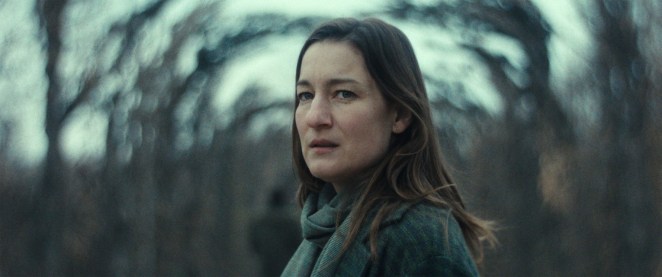
In “The Ugly Stepsister”, an uproarious Norwegian twist on the Cinderella fairytale screening at the Berlinale, Elvira (Norwegian actress Lea Myren) wants to win the prince but also loves eating cake.
Her money-obsessed mother (Polish actress Agnieszka Zulewska) gets her to swallow a tapeworm egg. It will consume the excess calories and make her slim, being slim will make the prince love her and marrying the prince will make the family wealthy. The tapeworm rumbles in her stomach for the rest of the film.
At mom’s behest, Elvira also undergoes several jaw-dropping beauty treatments. These include having her nose broken to reconstruct it, having new lashes sewn into her eyelids, with the camera hovering a hair’s breadth away, and — in a scene that reputedly made a viewer at Sundance throw up — chopping off the ends of her toes to fit the slipper. Elvira uses a meat cleaver for same.
The fact that home-administered foot surgery figured in the original Grimm Brothers version of Cinderella, but was airbrushed out by Disney, was one of the reasons director Emilie Blichfeldt said she made her 110-minute fantasy/horror/comedy romp “den stygge Stesøsteren”, in Norwegian, that has been delighting and shocking audiences here in equal measure.
“I struggled a lot when I was younger trying to fit within this insanely slim beauty ideal and was living under the burden of feeling ugly,” Blichfeldt told a Berlinale audience before a screening. “So I was in shock when I rediscovered this character from this world-known fairy tale.”
Blichfeldt’s is not the only film at this year’s Berlinale in which women have to deal with challenges that men might understand in the abstract, but could never experience firsthand.
Channeling “Rosemary’s Baby”
Austrian director Andreas Prochaska’s “Welcome Home Baby” channels Roman Polanski’s 1968 horror blockbuster “Rosemary’s Baby” in which a Satan-worshipping cult in a New York City brownstone can’t wait for the birth of actress Mia Farrow’s baby that has made her crave raw liver.
Austrian actress Julia Franz Richter, who bears more than a passing resemblance to Farrow, plays Judith, a Berlin paramedic who has learned she has inherited an old house in the Austrian backwoods from her estranged father. Her photographer partner Ryan (Dutch actor Reinout Scholten van Aschat) suggests she list it with an agency. But before doing so, Judith wants to visit the village and see if she can find out why her father and her long-dead mother abandoned her as a young child.
She and Ryan drive to what turns out to be a mansion that doubled as her father’s doctor’s office. Ryan tries to take pictures of the rooms to accompany a listing for sale, but the shots turn out blurred (poltergeists?). Meanwhile Judith, to her dismay, finds that the mostly elderly and female population of the village are expecting her to reopen her father’s practice. More than a dozen of them are in the waiting room shortly after her arrival.
It quickly becomes clear that despite Judith’s and Ryan’s plan to make a quick sale and return to their lives in Berlin, the women of the village have something else in mind, especially for her. For one reason after another their departure is delayed. Although Ryan has had a vasectomy, Judith discovers she is pregnant. Days turn into weeks turn into months and Judith realises she is trapped by what appears to be a cult of women who believe strongly in old traditions of motherhood and duty.
Plus she’s discovered a series of caverns leading to an underground altar, the wall of which is embedded with skulls, prominent among them one with her mother’s name on it.
So it’s not going to be a normal birth for Judith, nor does the delivery go well for orchestra conductor Julia (German actress Marie Leuenberger) in Austrian director Johanna Moder’s competition film “Mother’s Baby”.
Is that baby really mine?
Now in her 40s and desperate to have a child, Julia and her husband Georg (German actor Hans Löw) visit the fertility clinic of Dr. Vilfort (Danish actor Claes Bang) who is not only expensive but who Julia has heard has a questionable reputation. The smooth-talking Vilfort wins the couple over, however, by saying his patients almost never fail to conceive the first time.
Julia does conceive but when the baby boy is delivered something goes wrong and the infant is rushed out of the delivery room in Vilfort’s clinic before she or Georg sees it. Nor are she or her husband allowed to see it in the emergency ward and they don’t lay eyes on it for several days.
When a baby is eventually brought to her, Julia immediately is suspicious. For one, the baby is small and she’d been told the child she was carrying was big. For another, one of the team in the delivery room had remarked on how much hair Julia’s baby had. The one she is cradling is almost hairless.
Julia becomes convinced that the placid infant she brings home to her luxury flat with a powerful audio system is not hers. When she turns the volume way up, the baby doesn’t react. When she plays the violin right above him, ditto.
She consults Vilfort who says she is suffering from post-partum anxiety and gives her pills. As her obsession shows no sign of abating, Georg takes the baby and moves to his mother’s house. Vilfort visits him there to assure him everything is all right.
But Julia, undeterred in her pursuit of truth, gains entry to Vilfort’s clinic, where she discovers…
Did I mention the endangered Mexican axolotl that Vilfort gifts to Julia when she first takes the baby home? Or that an arrangement of Schubert’s lied “Der Erlkönig”, about a child assailed by a supernatural being, is played repeatedly on the soundtrack?
For more than that, you’ll have to see “Mother’s Baby”, and the others. All a hoot.
— By Michael Roddy
 Irish Arts News