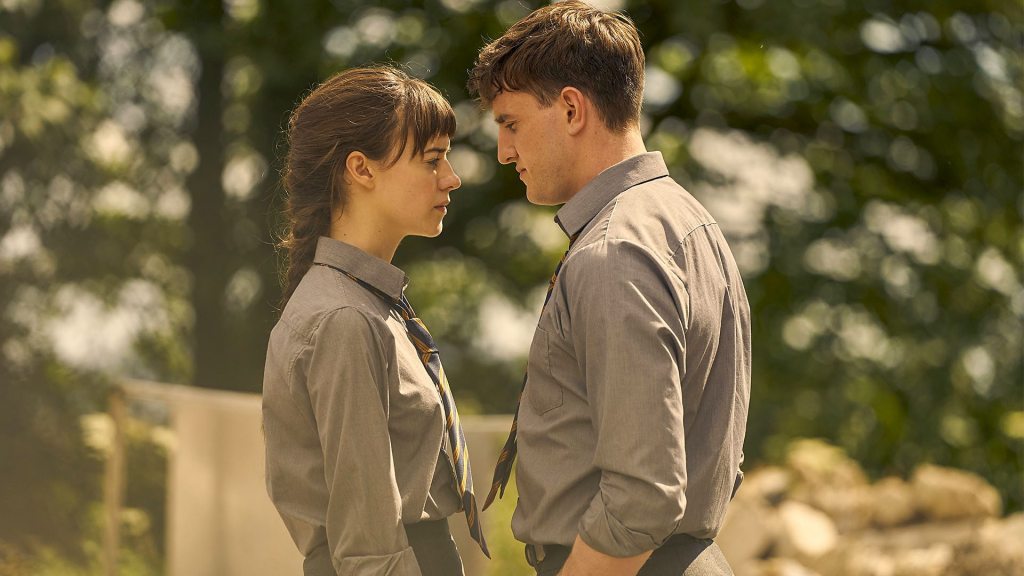
Daisy Edgar-Jones and Éanna Hardwicke in streaming hit “Normal People”
Twenty-seven-year-old Irish actor Éanna Hardwicke had no films screening at the 74th Berlinale, but he was invited anyway to participate in a showcase of rising European talent, and to celebrate this banner year for Ireland’s film and acting community, himself included.
“It definitely feels like Irish cinema has gone in a great direction and I think has been long before the kind of recent Oscar success,” he said. He was referring to the Academy Award nominations and wins for Irish films and for fellow Corkman Cillian Murphy, who is tipped to win the best actor Oscar next month for “Oppenheimer”, after winning the BAFTA gong for that same role earlier this month.
“You know, this isn’t just the last year. It’s been happening for decades and it’s…the culmination of a lot of hard work. What it means, I think, is the storytelling coming out of Ireland is just brilliant and I guess that leads to more opportunities for actors,” he added in an interview arranged as part of the European Shooting Stars programme.
Hardwicke, whose mother is Irish and father English, is soft-spoken and casual in conversation. He has been on the professional stage since he was 10, starting in productions with the now disbanded Corkadorka theatre company. A wider Irish audience first noticed him as one of the children of the main character in Conor McPherson’s supernatural drama “The Eclipse” from 2009.
Since then his face has become familiar throughout the world in the role of Rob Hegarty in the hit streaming adaptation of Sally Rooney’s novel “Normal People”. In the BBC series “The Sixth Commandment” he played the real-life English churchwarden and murderer Ben Field and he was the spooky taxidermist Silas in the Paramount+ series “The Doll Factory”.
He will play a journalist in an upcoming BBC series based on the infamous interview that Britain’s Prince Andrew gave on the Newsnight programme in which he tried to defend himself from allegations that he had sex with a 17-year-old girl trafficked by his friend, the late Jeffrey Epstein. There’s also an upcoming stage play, details of which are under wraps for now.
That’s already a lot, but Hardwicke is ready for much more.
“It’s like we’ve always known this, like we’ve always had these amazing actors and writers and directors, but now it’s getting a kind of an official recognition,” he said. “And we’re really lucky, right, because Irish actors and British actors, we get to play Americans all the time. I don’t know why…but it’s happening all the time.”
Following is an edited and shortened version of the interview.
IAN: How did you get into acting and what did your parents and family think of the idea?
EH: My family were really supportive and really encouraging of whatever any of us wanted to do. … (and) there’s quite a few of us. There’s seven. My mum sent me along…to do Saturday drama classes, and I would do some version of that pretty much for the rest of my childhood. And I just loved it, yeah. You know, I suppose if you’re lucky as a kid, you want to find your thing. So acting became my kind of thing, and after everything dropped off…that was still there.
IAN: So what was your first professional role?
EH: It was a production of Woyzeck…set in the Naval Base (in Cork). I was like 10, so I didn’t know really what was going on…I realised afterwards that they were hiding me from the darker stuff. The audience would be able to see me, but I couldn’t see what was going on on stage. So it was a very clever production, and only years later did I realise that’s what they were doing.
IAN: Instead of doing traditional university studies, you went to the Lir drama academy, which is part of Trinity College Dublin. What was that like?
EH: It is, would you believe, a degree. So I actually have, it’s technically a Level 8 degree, but I would have happily gone to university and studied English or History or something, but it was kind of a toss-up at one point, and then I did the auditions for Lir, and I just really loved it…I loved the people who were taking the auditions, and that kind of swung it for me, because I might have gone to university at that point…but I’m glad I didn’t.
IAN: Speaking of Woyzeck and dark, the four-part BBC series on the church warden Ben Field preying upon and poisoning vulnerable people in a rural community for their money is plenty grim. What does it do to an actor to play a role like that? Does it leave a lasting imprint?
EH: You do absorb what you’re doing, whether you want to or not. But for me it’s always an act of imagination. You’re just stepping into a role, and then you’re stepping out of it at the end of the day. So it … wasn’t like I was taking anything home with me. But what it was, was the story. The story left an indelible mark on all of us, because you’re sort of exploring it every day, and it was a harrowing and horrendous thing. And I think that leaves its mark.
IAN: You’re clearly an admirer — as is pretty much everyone in Ireland — of Cillian Murphy. What did you think of the film version of Claire Keegan’s novella “Small Things Like These” about the church-run Magdalene laundries in Ireland, in which Murphy stars and which opened the Berlinale?
EH: How great to see unglamourised Ireland as well, and not in a negative way, not in a way of, like, wasn’t it all doom and gloom back in the 70s in Ireland? It’s more complex than that. That home life in the film is so beautiful, right? It’s so warm. But life was hard. The skies were grey and I just thought it was great to see a depiction of Ireland that actually isn’t the rolling hills and the wild Atlantic.
IAN: What are your current projects and what would you like to do in future?
EH: I did a show called “A Very Royal Scandal”, which is about Prince Andrew — you remember the Newsnight interview that Prince Andrew gave? It’s three parts and it’s kind of half in the BBC Newsnight camp and half in the palace and in his sort of camp. So, it’s kind of a split screen look at it. And I play one of the journalists in the BBC.
IAN: And a lifetime dream role?
EH: The problem with naming your dream role is that you’ll never get to play it. That’s okay. So I’m thinking of… do you know what I would love to do? Sort of an epic set in Ireland…They tried to make (Flann O’Brian’s) “At Swim Two Birds”…That would be a project.
By Michael Roddy
 Irish Arts News