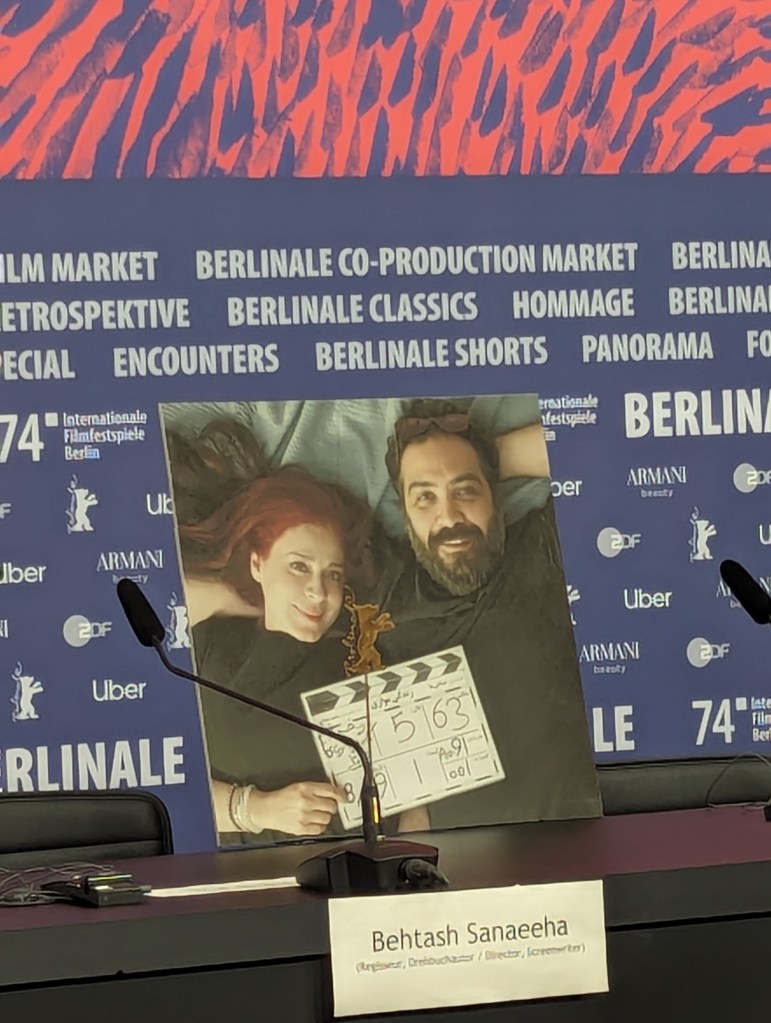
Two empty chairs and a photo of the Iranian co-directors of the Berlinale competition film “My Favourite Cake”, which takes aim at Iran’s strict morality rules and the country’s treatment of women, were placed on stage for a press conference on Thursday to protest a ban on the directors traveling to the film festival.
“Like parents who are forbidden from laying eyes on their newborn, we have been forbidden from enjoying the feeling of watching our film with you, the discerning audience of this important festival,” Maryam Moghaddam and Behtash Sanaeeha said in a joint statement released by the Berlinale.
“For years, Iranian filmmakers have been making films under restrictive rules, obeying red lines that, when crossed, can lead to years of suspension, prohibition and complicated court cases. A painful experience that we have tasted many times over these last years,” the statement said.
“We have come to believe that it is no longer possible to tell the story of an Iranian woman while obeying strict laws such as the mandatory hijab…This time, we decided to cross all of the restrictive red lines, and accept the consequences of our choice to paint a real picture of Iranian women — images that have been banned in Iranian cinema ever since the Islamic Revolution.”
The couple said earlier this month that the authorities had confiscated their passports in advance of the Berlin premiere of the film, called “Keyke mahboobe man” in Farsi.
The film’s two principal actors, Lily Farhadpour, who plays the septuagenarian widow Mahin, and Esmail Mehrabi, who plays the 70-year-old divorced taxi driver Faramarz, were in Berlin and fielded questions on behalf of the missing filmmakers.
Farhadpour’s character has decided she’s had enough of her lonely existence in a gardened house in a farflung district of Tehran. Her women friends who used to meet up regularly now come only once a year for lunch and mostly talk about their illnesses. One of the women attending Mahin’s luncheon says she’s brought along a video of her colonoscopy to show them.
Mahin’s grown-up children have left Iran and have children of their own. A video chat with her daughter is cut short when one of the daughter’s children demands help with toothbrushing, before Mahin can show off a new quilt she’s made for them.
Shortly afterwards, Mahin paints her nails, rouges her cheeks and heads off to a pensioners’ restaurant. There she sits alone while a nearby tableful of men have a lively time, but her gaze falls upon Faramarz, who is also eating at a table alone. She catches his name, finds out where he works and arranges to have him drive her home that night in the pouring rain.
In their conversation in his taxi, she makes no secret of her loneliness and he admits he feels the same. She invites him in for a late-night snack, retrieves an enormous bottle of red wine — banned in Iran — that has been concealed in a cupboard, and the party begins. Before long, her hijab is off and the two of them are dancing to pre-Islamic Revolution pop tunes and holding hands. They take a selfie in front of a potted plant and she bakes a cake for the two of them. In one of the film’s biggest laughs, they take a shower together — fully clothed. During the course of their time together, they admit that the evening is one of the best of their lives — even if that happiness will prove to be short-lived.
It’s a charming, funny but ultimately very moving film that apart from its direct jibes at Iran’s morality rules, requiring women to cover up in public and wear the hijab, touches on a universal theme of loneliness and love among people who are supposedly living their “golden years”.
“If you are portraying an elderly woman who’s in love it doesn’t have to be a good-looking woman, it can be that it’s just an old woman who’s maybe a bit overweight, it doesn’t have to be always the focus on beauty, when you just don’t show a hijab,” Farhadpour said.
“There are so many things we haven’t seen in Iranian cinema, there is so much in Iranian society we haven’t yet put on the screen.”
By Michael Roddy
 Irish Arts News